
Why Most MVPs Fail Before the First Line of Code
Most MVPs fail because founders validate vague assumptions. Learn how to define a focused user, problem, and measurable product hypothesis.
The Real MVP Failure Happens Before Development
Many startup ideas do not fail because the team cannot build them. They fail because the idea is too broad to test. “An app for freelancers,” “a better project tool,” or “AI for small businesses” describes a market direction, not a validated opportunity. Without a specific user, recurring problem, and observable outcome, an MVP becomes a collection of guesses disguised as a product.
This is where weak MVP strategy creates expensive momentum. Teams start designing dashboards, integrations, and polished onboarding before confirming that anyone urgently wants the core workflow. Customer discovery gets reduced to opinions from friends, survey responses, or general statements such as “I would use that.” Those signals rarely predict behavior. Effective product validation begins by narrowing the idea until a real person can recognize the problem, attempt a solution, and show meaningful commitment. The goal is not to prove that an app could be useful. It is to learn whether one focused workflow earns activation, completion, repeat usage, or payment from a clearly defined audience.
Turn a Broad Idea Into a Testable Hypothesis
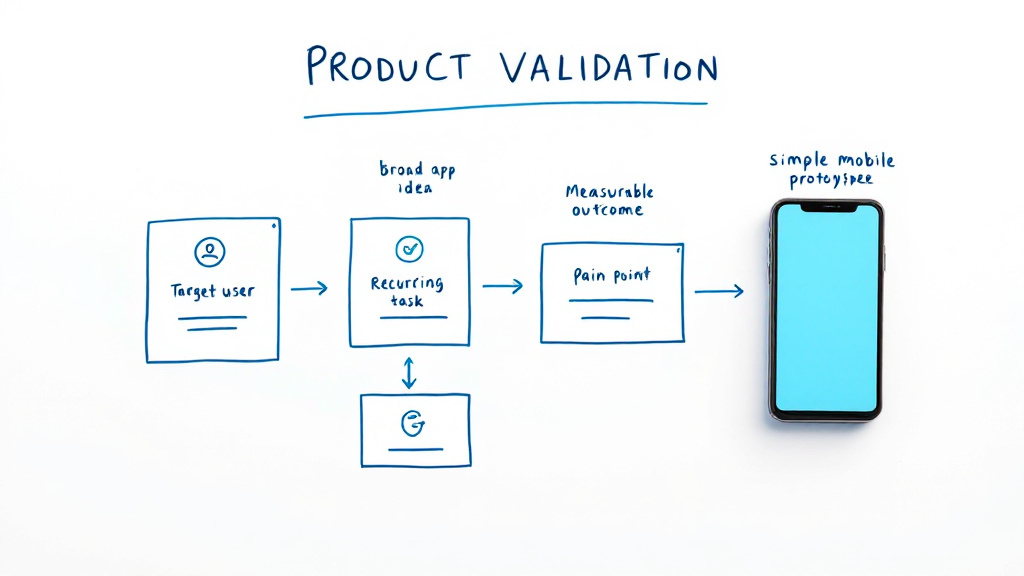
A practical validation hypothesis connects four elements: a defined user, a recurring task, a painful obstacle, and a measurable result. For example: “Independent freelance designers who lose time chasing project feedback will use a simple client approval workspace to complete reviews faster.” This statement is stronger than “a collaboration app for creatives” because it identifies who experiences the problem, what they repeatedly do, and what improvement the product must create.
Next, separate assumptions from facts and rank them by risk. Is the audience easy to reach? Does the problem happen frequently? Are users already spending time or money on workarounds? Will they complete the proposed task without extensive instruction? A lightweight MVP should test the riskiest assumptions first, not showcase every possible feature. Create a responsive prototype with simple onboarding, authentication, and one core workflow. Then define success before launch: perhaps 60% of invited users activate, half complete the task, and 20% return within seven days. This approach turns startup ideas into experiments and gives customer discovery a clear evidence trail.
Measure Behavior Before You Build the Roadmap

Validation becomes valuable when it measures what people do rather than what they say. Invite a small, relevant group to use the prototype and track the full journey: landing-page conversion, sign-up, activation, completion of the core task, feedback, repeat visits, and willingness to pay. Each event answers a different question. Sign-ups may indicate curiosity, while repeated task completion suggests the product is becoming useful. Payment intent adds evidence that the problem has economic importance.
Use the results to make a decision, not to justify continued building. Strong activation with weak retention may indicate that the first experience works but the problem is not recurring. High engagement with no payment may point to a low-value audience or the wrong pricing model. Low conversion can reveal a positioning problem before it becomes an engineering problem. A workspace such as FixFar helps founders connect a focused prototype, qualitative feedback, and behavioral analytics in one loop. The outcome is a disciplined build, revise, or stop decision. That is the purpose of an MVP: not to launch a small version of a large product, but to discover whether a narrow product deserves to exist.